
Éva Á. Csató:
Over more than twenty years Éva Á. Csató carried out field work in the Karaim communities of Lithuania and Ukraine to document their linguistic heritage. Over fifteen years she organized summer schools in Lithuania to support the community’s efforts to maintain their cultural heritage, especially the Karaim language. She has given Karaim distance courses at university level and written a Karaim grammar and text books for adults and children. Together with David Nathan and Karina Firkavičiūtė, she has published several multimedia resources, e.g. the Karaim multimedia CD. Her publications on Karaim are listed on the Publications page.
Karina Firkavičiūtė:
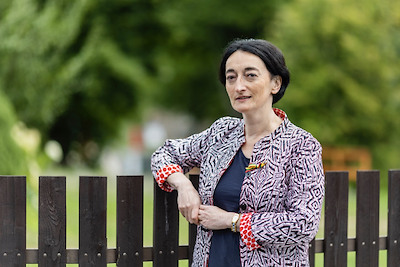
Karina Firkavičiūtė is Assoc. Prof., Doctor of Humanities, Musicologist, Master of Interdisciplinary European Studies. As well as her professional activities, since 1997 she had led the Lithuanian Karaim Association of Culture. She is also one of the 30 people in the world who still speak their native Karaim language.
Amongst her Karaim culture-related activities, she has authored and compiled several books, articles about Karaim music (e.g. Zycie w piesni karaimskiej), cultural heritage and Karaim language (e.g. Karaim language in use). She edited, translated and compiled the Karaim poetry anthology “Į Trakus paukšiu plasnosiu” (1997, J. Savičius Prize), edited and published “Karaim calendar 2001–2051” (2001); co-edited ‘Bir kiuń ėdi’ (2015), together with her mother Halina Kobeckaite, translated Antoine de Saint-Exupery’s “The Little Prince” into Karaim (“Kiči Bijčiek”, published by Edition Tintenfass in 2018), contributed to the translation of the Liturgical Prayer of the Karaim Rites from Karaim into Lithuanian (2023). In 2024, she translated the text of the Užupis (Vilnius’ district) Constitution into Karaim.
She is active as the initiator, author, and implementer of many projects aimed at preserving and nurturing the Karaim cultural heritage, including the Karaim language. All the main activities are published on the community’s webpage www.karaim.eu. In 2019, under her leadership Lithuanian Karaim wedding tradition was included in the Lithuania’s Intangable Cultural Heritage inventory which resulted in the creation of the video story Karaim Wedding. One of her most recent and influential projects was the initiation and implementation of the Karaim Year in Lithuania (2022) that included over 70 various activities (e.g. Statistics survey, music drama, several exhibitions, concerts, publications, and many other events).
in 2024-2025, she initiated and contributed to the creation of video stories about famous Karaim people including Mykolas Firkovičius and Aleksander Dubinski.
Karina Firkavičiūtė relies on the long-established ethical principles of the community, mobilizing all members of the community for joint work, especially the younger generation, which, by embracing the heritage accumulated by their ancestors, ensures the continuity of the Karaim people in Lithuania. She promotes not only Karaim culture, but also the care provided by the Lithuanian state for all its national minorities, thus encouraging the preservation of national identity and tolerance towards others. For her long-standing promotion of Karaim culture, she was awarded several prizes by the Lithuanian Department of National Minorities (2016, 2019, 2026), the Lithuanian Association of Municipalities (2022), and the State Award – Medal of the Order for Merit to Lithuania (2022).
David Nathan:
David trained in linguistics, computing, and management. In 1995, he co-authored the world’s first web dictionary, for Gamilaraay, with Peter K. Austin. Since then, he has taught computing, linguistics, field methods, cognitive science, and multimedia, with publications on archiving, language documentation, audio, internet, lexicography, and Australian and Taiwanese Indigenous languages. As Director of the Endangered Languages Archive at SOAS University of London, his team developed new approaches to archiving language documentation and trained a generation of linguists in technologies and methods for documentary linguistics. He recently retired as community linguist for the Groote Eylandt Language Centre. He has developed and published multimedia language materials for Karaim with Éva Á. Csató and Karina Firkavičiūtė, and has produced several key multimedia and web resources for Australian languages.