
Featured publication | Recent publications | Journal: Turkic Languages | Library resources | Online resources
Featured publication
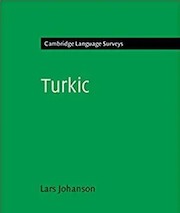
Turkic (Lars Johanson, 2021, republished 2026 in paperback)
Now re-published in paperback form, Cambridge Languages Surveys: Turkic will be available from August 27th 2026.
The volume provides a full description of the features of the Turkic languages, covering structural, functional, historical, sociolinguistic and literary aspects. It presents the history and cultures of the speakers, together with detailed descriptions of the linguistic structures and usage of languages including Turkish, Azeri, Turkmen, Tatar, Kazakh, Uzbek, and Uyghur. It is a valuable resource for academic researchers, students of linguistic typology and comparative linguistics, for general readers, and for all those involved in Turkic studies. View the Table of Contents here.
Available from the publisher CUP here.
Recent publications
Linguistic and Philological Turcology. Studies in Honour of Hendrik Boeschoten (Emine Yılmaz, Hasan Güzel & Emre Çetinkaya eds., 2026)
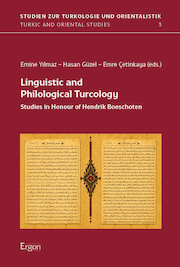
This volume contains eighteen contributions by colleagues, students and friends of the Dutch Turcologist Hendrik Boeschoten, who passed away in 2024. Topics include Turkic philology and linguistics, the history of Turkic studies and lexicography, pre-modern languages Old Uyghur, Ottoman Turkish and Middle Kipchak, and modern varieties of Turkish, Uyghur, and Turkic languages of Iran. Lars Johanson & Éva Á. Csató have contributed the chapter On the language of the Alexander stories: What Rik Boeschoten wanted to tell us.
Available from the publisher Nomos here.
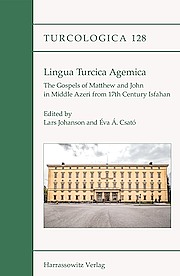
Lingua Turcica Agemica: The Gospels of Matthew and John in Middle Azeri from 17th Century Isfahan (Lars Johanson & Éva Á. Csató eds., 2025)
In: Turcologica 128. This volume is an edition of a Middle Azeri translation of the Gospels of Matthew and John from the late17th century, originally compiled by French nobleman Balthasar de Lauzière in Isfahan. The manuscript is preserved in the Oriental collection of Johan Gabriel Sparwenfeld (1655–1727) at Carolina Rediviva, Uppsala University Library, Sweden. The Introduction describes the story of the manuscripts and their journey to Uppsala. The text of the Bible translations consists of facsimile images together with transcriptions and grammatical notes. A glossary of lexical and grammatical items is included.
Lingua Turcica Agemica, the language of the translation, is the Turkic lingua franca used in the era of the Turkic speaking Safavids in Iran. The volume also contains a short grammar of this Turkic variety written in 1684 by the French Capuchin friar Raphaël du Mans’ (1613–1696) as well as its French version by Balthasar de Lauzière.
Available from the publisher Harrassowitz here.
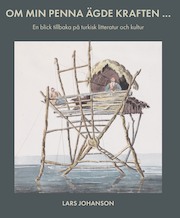
Om min penna ägde kraften … En blick tillbaka på turkisk litteratur och kultur (Lars Johanson, 2024)
[English title: If my pen possessed the power: A Look Back at Turkish Literature and Culture]
Lars Johanson’s writings on Turkish literature and culture, many for the first time in Swedish translation. Articles include an introduction to the Turkish world and the peculiarities of the Turkish language, and discussion of the works of Turkish writers and their problems with the politics and the role of Turkology in the Swedish academic environment.
Available from the publisher here.
The verb in Northeastern Turkic (Éva Á. Csató, Lars Johanson, Birsel Karakoç & Irina Nevskaya, 2024)
In: Vajda, Edward (ed.) The Languages and Linguistics of Northern Asia. 2. Typology, Morphosyntax and Socio-Historical Perspectives. (The World of Lingustics 10.2.) Berlin & Boston: De Gruyter Mouton. 919–1006. The chapter deals with the Turkic languages spoken in northern and southern Siberia and gives an account of their verb systems.
Available from the publisher De Gruyter Brill here.
Encyclopedia of Turkic Languages and Linguistics Online (Lars Johanson ed., 2023)
This comprehensive reference work describes Turkic languages ranging from Old Turkic to the languages and varieties spoken today. It covers research in Turkic linguistics and includes the following topics:
- The languages of the Turkic language family, their structure, and their history
- Writing systems used for Turkic languages, their emergence, development, and current use
- The history of Turkic linguistics
- The acquisition of Turkic languages
- Language contact, areal linguistics, and multilingualism
- Turkic dialect studies
- Computational linguistics of Turkic languages
- Generative approaches to Turkish
- Turkish sign language
- Up-to-date bibliographical information
Available from the publisher Brill here.
Aspect in the Languages of Europe (Lars Johanson, 2023)
This volume deals with the typology of verbal aspect in the languages of Europe, including representatives of the Indo-European language family, several Turkic and Finno-Ugric languages, the Mongolic language Kalmyk, the Semitic language Maltese, the languages of the Caucasia, and Basque.
Available from the publisher here.
Code Copying: The Strength of Languages in Take-over and Carry-over Roles (Lars Johanson, 2023)
This book presents Lars Johanson’s Code-Copying Model, an integrated framework for the description of contact-induced processes. The model covers all the main issues, both synchronic and diachronic, in contact phenomena. Examples from a wide range of languages illustrate the model’s applicability to both spoken and written language.
Available from the publisher Brill here.
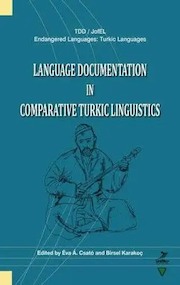
Language Documentation in Comparative Linguistics (Éva Á. Csató & Birsel Karakoç eds., 2023)
Special Issue of Journal of Endagered Languages. Volume 13: 23. Ankara. The volume presents case studies advocating for standardization of text representations and linguistic descriptions based on the international scholarly tradition in comparative Turkic linguistics.
Available from the publisher DergiPark Akademik here.
Turkic (Lars Johanson, 2021)
This volume covers structural, functional, historical, sociolinguistic and literary aspects of the Turkic languages. It presents the history and cultures of several Turkic languages including Turkish, Azeri, Turkmen, Tatar, Kazakh, Uzbek and Uyghur.
Available from the publisher CUP here.
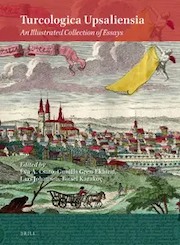
Turcologica Upsaliensia: An Illustrated Collection of Essays (Éva Á. Csató, Gunilla Gren-Eklund, Lars Johanson & Birsel Karakoç, 2021)
The richly illustrated essays in the book tell the stories of scholars, travellers, diplomats and collectors who made discoveries in the Turkic-speaking world while affiliated with Sweden’s oldest university, at Uppsala.
Available as hardback or PDF from the publisher Brill here.
The Turkic Languages (Editors Lars Johanson & Éva Á. Csató, 2021)
This revised edition describes the historical development and linguistic features of the Turkic language family, whose languages span from southern Iran to the Arctic Ocean and from the Balkans to the Great Wall of China. Turkic languages are particularly interesting due to their morphosyntactic regularity, their wide geographical distribution, and their stability over time. Languages covered include Azeri, Bashkir, Chuvash, Gagauz, Karakalpak, Kazakh, Kirghiz, Noghay, Turkish, Tatar, Turkmen, Uyghur, Uzbek, Yakut, Uyghur, and languages of Iran and South Siberia.
Available from the publisher Taylor & Francis here.
Clause chaining in Turkic (Lars Johanson, Éva Á. Csató & Birsel Karakoç, 2024)
This chapter by Lars Johanson, Éva Á. Csató & Birsel Karakoç focuses on clause chaining phenomena in the Turkic languages. It appears in the volume Clause Chaining in the Languages of the World (Hannah S. Sarvasy & Alexandra Y. Aikhenvald eds.) which describes clause chains across the world’s languages using a typological perspective, covering a range of languages, language families, and linguistic areas.
Available from the publisher OUP here.
The classification of the Turkic languages (Lars Johanson, 2020)
In: The Oxford Guide to the Transeurasian Languages / [ed] Robbeets, Martine; Savelyev, Alexander, Oxford: Oxford University Press, 2020, p. 105-114.
Available from the publisher OUP here.
The Northwestern Turkic (Kipchak) languages (Lars Johanson & Éva Á. Csató, 2020)
In: The Oxford Guide to the Transeurasian Languages / [ed] Robbeets, Martine; Savelyev, Alexander. Oxford: Oxford University Press, 2020, p. 370-391. This volume discusses the historical connection between the Turkic, Japonic, Koreanic, Tungusic, and Mongolic language families.
Available from the publisher OUP here.
Ambiguous Verb Sequences in Transeurasian Languages and Beyond (Éva Á. Csató and Birsel Karakoç eds., 2020)
In: Eva Á. Csató and Birsel Karakoç (eds.) Turcologica 120. Wiesbaden: Harrassowitz. This volume presents an analysis of ambiguous verb sequences and ways of teasing them apart, an issue that has never before been addressed in the typological literature.
Available from the publisher here.
Grammaticalization in Turkic (Lars Johanson & Éva Á. Csató, 2018)
In: Heiko Narrog & Bernd Heine eds. Grammaticalization from a Typological Perspective. 2018, p 146–165. This volume is the first to bring together the topics of grammaticalization and typology.
Available from the publisher OUP here.
Journal: Turkic Languages
Founded by Lars Johanson.
Editors: Éva Á. Csató, Birsel Karakoç, Elisabetta Ragagnin, in cooperation with Pietro Bortone, Peter B. Golden, Tooru Hayashi, Astrid Menz, Irina Nevskaya, Sumru A. Özsoy, Christopher Schroeder, and Saule Tazhibayeva
The journal Turkic Languages addresses descriptive, comparative, synchronic, diachronic, theoretical and methodological issues in the study of Turkic languages including genetic, typological and areal relations, linguistic variation, and language acquisition. It is indexed in the Art and Humanities Citation Index and in Scopus.
The journal welcomes contributions on all aspects of Turkic language studies. It uses a double blind review system in selecting articles for publication, and is published in one volume of two issues per year with approximately 300 pages. The preferred language of publication is English.
Send manuscripts or reviews proposed for publication, or correspondence concerning editorial matters, to Prof. em. Éva Á. Csató, Department of Linguistics and Philology, Uppsala University, Uppsala, Sweden, eva.csato@lingfil.uu.se. Books will be reviewed as circumstances permit. Publications received will not be returned.
The journal is published by Harrassowitz as ISSN 1431-4983 and is available here.
Most recent issue: Turkic Languages, Vol. 30 2026, Number 1.
Vol. 30, 2026, Number 1: Table of Contents
| Lars Johanson (1936–2025) | 1 |
| Stephan Specht: Farewell | 3 |
| Editorial note by The Editors | 5 |
Obituaries | |
|---|---|
| István Vásáry: In memoriam Zsuzsanna Kakuk (1925–2025) | 7 |
| Elisabetta Ragagnin: In memoriam Larry V. Clark (1943–2025) | 11 |
Articles | |
| Aynur Abish & Juldyz Smagulova: Specificity and accusative case marking in Kazakh | 18 |
| Mehmet Akkuş & Soheila Ahmadi: Selectively copied analytic prospective in Khalaj | 38 |
| Nazmiye Çelebi & Osman Erciyas: Bynames in Cypriot Turkish in the context of language contact | 57 |
| Shinji Ido: The elusive vowel inventory of standard Uzbek | 80 |
| Marina Osorova: Dialectal phytonymic vocabulary in Yakut and South Siberian Turkic | 103 |
| Engin Evrim Önem: Processing focus and scrambling in Turkish question-answer pairs | 120 |
Reports | |
| Orçun Ünal: Report on the 66th Annual Meeting of the Permanent International Altaistic Conference (PIAC), Göttingen, 30 June–5 July 2024 | 144 |
| Sema Aslan Demir & Mevlüt Erdem: Turkologentag 2025. Fifth European Convention on Turkic, Ottoman and Turkish Studies, Johannes Gutenberg University Mainz, Department of Turcology, Mainz, Germany, 18–20 September 2025 | 151 |
Appendix | |
| Transcriptions and Notations. Glosses | |
Library resources
Uppsala University, DIVA
Uppsala University’s Library has a rich collection of digital materials and serves as a valuable resource for researchers. See particularly the collection Turkic cultural heritage in Uppsala. In the university’s DIVA database you can search the publications of scholars affiliated with the university, including Lars Johanson and Éva Á. Csató.
Szeged University
Szeged University’s library, The Klebelsberg Library, has a large Oriental collection containing donations from great Turcologists. Recently, Lars Johanson and Éva Á. Csató have also donated their books to this library. The online catalogue provides a rich source for searching literature on Turkic linguistics.
Online resources
The Turkish Suffix Dictionary is an interactive encyclopedia covering the full range of word suffixes in Turkish, together with their variants and usage examples. It was created by Éva Á. Csató & David Nathan and it aims to help those who are learning Turkish as a second or foreign language.